It’s April 25th, 2026, and the AI arms race has entered yet another warp-speed phase. Just this week, OpenAI launched GPT-5.5. Anthropic debuted Claude Opus 4.7, and Google Gemini released its Enterprise Agent Platform. Each iteration promises faster inference, better reasoning, and deeply integrated agentic capabilities. Theoretically, these updates should revolutionize our workflows.
But on the ground, the reality remains far more complicated for those actually implementing these tools. Model capabilities have skyrocketed over the past two years. However, a persistent problem remains. We still struggle to truly trust any single one of them. This is exactly why AI orchestration is becoming the critical lifeline for enterprises today.
The Standardization Problem Before AI Orchestration
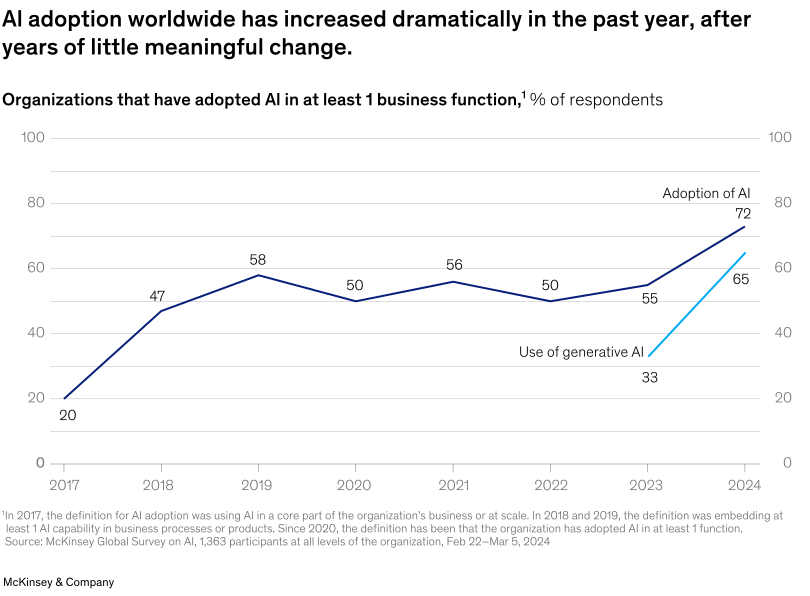
Back in 2023 and 2024, low-code AI tools like n8n, Lovable, and Cursor dominated the landscape. They promised to bridge the gap. They gave developers quick-deploy tools to connect powerful new models to existing systems. Optimism about AI democratization filled the headlines, much like what we covered in our past breakdown of the 2024 AI landscape. In 2024, AI adoption had already increased manifold worldwide, especially with the introduction of connecting tools.
Since then, we’ve seen a natural correction. n8n has largely faded from the mainstream enterprise conversation. Lovable found its niche as a prototyping tool for non-developers rather than a robust production solution. Cursor faces increasing pressure from Claude Code’s deep vertical integration. Even more concerning, many highly hyped tools simply vanished before enterprise adoption could even begin.
This fragmentation represents the central challenge facing enterprise AI strategy today. The technology is undeniable, as seen in the latest model benchmarks from industry leaders, but the surrounding tooling remains unstable. Customers find it impossible to standardize on a single, dependable tool because the ground constantly shifts.
Juggling Models, Burning Tokens
This fragmentation leaves IT and product teams in a costly predicament. To achieve the best results, teams must “model juggle.” They route specific tasks to different providers. For instance, they use GPT-5.5 for creative writing, Claude 4.7 for code synthesis, and Gemini for broad information retrieval.
While this approach maximizes quality, it introduces immense operational overhead:
- Token Burn: Managing multiple APIs wastes millions of tokens on redundant workflows. This drives up costs significantly.
- Centralization Failure: Enterprises rarely possess a unified “single pane of glass” for AI automation. Instead, organizations must manage a brittle patchwork of connections.
- Vendor Lock-In: Relying heavily on one tool leaves companies vulnerable. They face risks from vendor service failures, model hallucinations, price hikes, or sudden shutdowns.
Enterprises have recognized this instability for some time. However, the AI imperative sweeps across every sector, making “wait and see” a failing strategy. Every organization feels pressured to build AI-powered products and become fundamentally AI-native.

What the Research Says: The Case for Dynamic Routing
The shift toward AI orchestration is strongly supported by recent academic research. For example, the foundational FrugalGPT framework demonstrated that adaptively routing queries to different models based on complexity could match the performance of top-tier models while achieving up to a 98% cost reduction (Chen et al., 2023). Building on this concept, later research introduced advanced model routing engines like OptiRoute, which dynamically select the optimal large language model by balancing both functional criteria, such as accuracy and cost, and non-functional requirements, including ethical considerations (Piskala et al., 2025). This proves that relying on a single monolithic model is not only inefficient but also increasingly outdated in an enterprise setting.
The Path Forward: Orchestration and Abstraction
The chaos of 2026 demands a strategic shift. We must move away from simply adopting models and toward building robust AI orchestration layers. Companies cannot afford to rebuild internal automation every time a new model drops or a tool fades away.
The next phase of AI maturity introduces the AI Gateway and Abstraction Layer. Rather than connecting applications directly to GPT-5.5 or Claude 4.7, enterprises should look to invest in centralized, secure middleware.
This middleware offers several key advantages:
- Model Agnosticism: The orchestration layer abstracts away the underlying model’s specific API. Applications make a generic call for a task, like summarizing a document. The gateway then routes this request to the most optimal model based on performance, cost, or availability.
- Unified Governance and Security: This layer enforces security policies and data privacy. It prevents sensitive PII leaks to public APIs and monitors for hallucinations or biased outputs.
- Cost Management: A centralized gateway implements advanced routing logic. It caches common queries and monitors token usage across different models to optimize spending.
- Resiliency: If one provider experiences an outage, the gateway automatically fails over to an alternative model. This ensures seamless business continuity.
The era of trusting a single AI “black box” is over. The future belongs to organizations that build infrastructure to manage, secure, and swap these powerful tools. This approach helps them finally regain control over their AI destiny. these powerful tools as needed, regaining control over their AI destiny.
References
Chen, L., Zaharia, M., & Zou, J. (2023). FrugalGPT: How to Use Large Language Models While Reducing Cost and Improving Performance. arXiv. https://doi.org/10.48550/arxiv.2305.05176 Cited by: 653
Piskala, D. B., Raajaa, V., Mishra, S., & Bozza, B. (2025). Dynamic LLM Routing and Selection based on User Preferences: Balancing Performance, Cost, and Ethics. International Journal of Computer Applications, Vol. 186, No. 51, November 2024, pp. 1-7. https://doi.org/10.5120/ijca2024924172 Cited by: 10
https://www.mckinsey.com/capabilities/quantumblack/our-insights/the-state-of-ai-2024






Leave a Reply